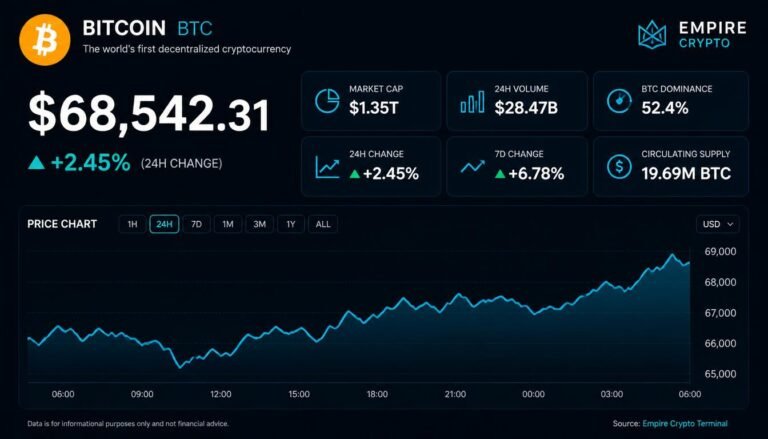
Risk management in crypto trading is essential for protecting capital, reducing losses, and ensuring long-term success in volatile markets. It includes stop-loss use, position sizing, diversification, and emotional control. At the core, Empire Crypto helps traders understand disciplined strategies to manage risk effectively and trade more consistently with confidence in crypto markets.

What is Risk Management in Crypto Trading?
Risk management in crypto trading refers to the process of identifying, analyzing, and minimizing potential losses while trading cryptocurrencies. It ensures that no single trade can significantly damage your overall portfolio.
At its core, it is about protecting capital first and making profits second.
Key components include:
- Position sizing
- Stop-loss placement
- Portfolio diversification
- Risk-reward ratio planning
- Emotional discipline
Without structured risk management in crypto trading, traders often fall into emotional decision-making, leading to overtrading and major losses.
Why Risk Management is Crucial in Crypto Markets
The cryptocurrency market is highly volatile compared to traditional financial markets. Bitcoin and altcoins can experience massive price swings within minutes.
Here’s why risk management in crypto trading is critical:
- Market volatility can wipe out positions quickly
- Emotional trading leads to impulsive decisions
- Leverage increases both profit and loss risks
- Market manipulation is common in low-cap tokens
- Lack of regulation increases uncertainty
Many traders underestimate these risks and lose capital within weeks. Proper planning is the only way to survive long term.
At this stage, Empire Crypto emphasizes that disciplined trading is more important than finding “perfect entries.”
Core Principles of Risk Management in Crypto Trading
1. Never Risk More Than You Can Afford to Lose
A fundamental rule in risk management in crypto trading is simple: only invest what you can afford to lose.
2. Use the 1–2% Rule
Professional traders risk only 1–2% of their total portfolio per trade.
Example:
- $1,000 portfolio → risk only $10–$20 per trade
3. Focus on Risk-Reward Ratio
A good trade should offer at least a 1:2 risk-reward ratio.
4. Preserve Capital First
Your goal is survival, not instant wealth.
At Empire Crypto, traders are encouraged to prioritize capital preservation above everything else.
Position Sizing: The Foundation of Risk Control
Position sizing determines how much capital you allocate per trade. It is one of the most important aspects of risk management in crypto trading.
How to Calculate Position Size
Formula:
Risk Amount ÷ Stop Loss Distance = Position Size
Example:
- Capital: $1,000
- Risk: 2% ($20)
- Stop loss distance: 5%
Position size = $400
Common Mistakes
- Investing too much in one trade
- Ignoring stop-loss levels
- Increasing size after losses
At this stage, Empire Crypto recommends using consistent position sizing to avoid emotional trading behavior.
Stop Loss and Take Profit Strategy
Stop-loss and take-profit levels are essential tools in risk management in crypto trading.
Take profit locks in profits when the target price is reached.
What is a Stop Loss?
A stop loss is an automatic order that closes your trade when the price reaches a predefined loss level. It helps limit potential losses and protect your trading capital.
What is Take Profit?
A take profit order automatically closes your trade when the price hits a target profit level. It ensures that gains are secured without needing to constantly monitor the market.
Why They Matter
- Prevent emotional decisions
- Protect capital from sudden crashes
- Lock in consistent profits
Example Strategy
- Entry: $100
- Stop Loss: $95
- Take Profit: $115
Risk-reward ratio: 1:3
Empire Crypto highlights that every trade should have predefined exit points before entering.
Diversification in Crypto Trading
Diversification reduces overall portfolio risk by spreading investments across multiple assets.
Benefits of Diversification
- Reduces exposure to single asset failure
- Balances market volatility
- Improves long-term stability
Types of Diversification
- Across cryptocurrencies (BTC, ETH, altcoins)
- Across sectors (DeFi, NFTs, Layer 1, gaming tokens)
- Across trading strategies
However, over-diversification can reduce focus and returns.
At Empire Crypto, traders are encouraged to maintain a balanced and strategic portfolio.
Understanding Leverage and Its Risks
Leverage allows traders to control larger positions with smaller capital. While it increases profits, it also increases losses.
Example of Leverage
- 10x leverage means $100 controls $1,000 position
Risks of High Leverage
- Liquidation risk
- Emotional trading pressure
- Rapid account depletion
Safe Leverage Practices
- Beginners: 2x–5x max
- Experienced traders: controlled usage only
Risk management in crypto trading becomes extremely important when leverage is involved.

Trading Psychology and Emotional Control
Even with perfect strategies, emotions can destroy trading performance.
Common Emotional Mistakes
- Fear of missing out (FOMO)
- Panic selling
- Revenge trading
- Overconfidence after wins
How to Control Emotions
- Stick to trading plan
- Avoid overtrading
- Take breaks after losses
- Keep a trading journal
Empire Crypto strongly believes that mindset is 50% of trading success.
Beginner Mistakes in Risk Management
Many beginners fail because they ignore basic principles of risk management in crypto trading.
Common Mistakes
- No stop-loss usage
- Overtrading daily
- Investing all capital in one coin
- Following hype coins blindly
- Ignoring risk-reward ratios
How to Avoid Them
- Start small
- Learn before scaling
- Follow strict rules
- Focus on consistency
At Empire Crypto, beginners are guided to build discipline before chasing profits.
Advanced Risk Management Strategies
Once you understand the basics, you can move to advanced techniques.
Scaling In and Out
Scaling in and out means entering or exiting a trade in multiple stages instead of all at once. This helps manage risk and improves flexibility in volatile markets.
Hedging Positions
Hedging involves opening opposite trades to reduce overall risk exposure. It can help balance potential losses if the market moves against your main position.
Correlation Analysis
Correlation analysis focuses on understanding how different assets move in relation to each other. Avoiding highly correlated trades helps reduce concentrated risk in a portfolio.
Volatility-Based Position Sizing
This strategy adjusts trade size based on how volatile the market is. Higher volatility usually requires smaller positions to manage risk effectively.
Advanced traders at Empire Crypto use these methods to maintain more consistent and disciplined performance.
Real-Life Crypto Trading Example
Let’s understand risk management in crypto trading with a simple scenario:
Scenario
A trader has $2,000 capital.
- Risk per trade: 2% = $40
- Trade setup: Bitcoin breakout
- Entry: $30,000
- Stop loss: $29,400 (2%)
- Take profit: $31,800 (6%)
Outcome
Even if 5 trades fail, the trader only loses $200 total, but one successful trade can recover losses and generate profit.
This is how disciplined trading works in practice.
At Empire Crypto, such structured planning is strongly recommended for all traders.
Tools for Risk Management in Crypto Trading
Trading Tools
- TradingView charts
- Binance risk calculator
- Portfolio trackers
- Stop-loss automation tools
Key Metrics to Track
- Win rate
- Risk-reward ratio
- Maximum drawdown
- Average profit/loss
Using these tools helps improve decision-making and consistency.
About Empire Crypto Data and Trading Insights
Empire Crypto focuses on educating traders about structured and disciplined trading practices. It provides insights, market analysis, and educational resources designed to improve decision-making in volatile markets.
The goal is to help traders understand risk management in crypto trading in a practical and simplified way. It also emphasizes long-term sustainability over short-term gains, helping traders avoid emotional mistakes.
Through educational content, it supports both beginners and intermediate traders in building strong trading foundations. By following these principles, traders can gradually improve consistency and reduce unnecessary risks. Many learners use its resources to understand real market behavior and apply structured strategies.
Frequently Asked Questions (FAQ)
1. What is risk management in crypto trading?
It is the process of controlling losses and protecting capital while trading cryptocurrencies.
2. Why is risk management important?
Because crypto markets are highly volatile and can lead to rapid losses without proper control.
3. How much should I risk per trade?
Ideally, 1–2% of your total trading capital.
4. Is leverage safe in crypto trading?
Leverage is risky and should be used carefully, especially by beginners.
5. Can beginners succeed without risk management?
No, beginners who ignore risk management usually lose capital quickly.
6. What is the best risk-reward ratio?
A minimum of 1:2 is recommended.
7. Do professional traders use stop-loss?
Yes, stop-loss is essential for all professional trading strategies.
Conclusion: Build a Safer Trading Future
Risk management in crypto trading is not optional—it is essential for survival in the crypto market. Without it, even skilled traders can lose everything. With it, even beginners can build consistency over time.
The key is discipline, patience, and structured planning. Focus on protecting your capital before chasing profits. Empire Crypto believes that long-term success comes from smart risk control, not emotional trading. By applying these principles, you can transform your trading journey and reduce unnecessary losses.
If you want to grow as a trader, start treating risk management in crypto trading as your number one priority. Empire Crypto encourages every trader to practice, learn, and stay consistent in their journey toward financial growth.