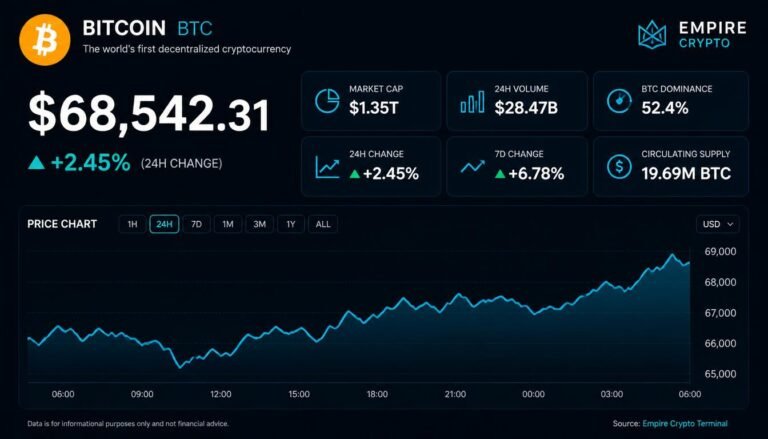
Bitcoin remains the king of the digital asset landscape. When Bitcoin moves, the entire market reacts. In this masterclass, Empire Crypto lays out the powerful Bitcoin trading tips you need to secure a winning edge, manage your risk, and trade with absolute confidence.

Why Bitcoin Trading Requires a Data-Driven Approach
Cryptocurrency trading is often mischaracterized as gambling, but serious traders know that consistent profits stem from detailed technical analysis, disciplined risk management, and reliable market metrics. Without structured analytics, market fluctuations can trigger emotional decisions that erode capital.
To trade Bitcoin effectively, you must rely on actionable metrics rather than intuition. Using top-tier crypto data allows traders to spot macro trends, track liquidity pools, and execute orders with precision.
+-----------------------------------------------------------------------+
|                       TRADING SUCCESS TRIAD                           |
|                                                                       |
|         +-------------------+       +-------------------+             |
|         | Technical Analysis|       | Risk Management   |             |
|         |  (Charts & Tools) |       | (Stop Loss / DCA) |             |
|         +---------+---------+       +---------+---------+             |
|                   \                           /                       |
|                    \                         /                        |
|                     +-----------------------+                         |
|                     | Data Reliability      |                         |
|                     | (Metrics & Insights)  |                         |
|                     +-----------------------+                         |
+-----------------------------------------------------------------------+
Integrating precise cryptocurrency market data into your daily routine transforms market volatility from a risk into a massive profit opportunity.
Beginner Bitcoin Trading Tips: Building a Strong Foundation
Every successful market participant begins with solid fundamentals. Before placing advanced orders or leveraging positions, focus on mastering key concepts that preserve your capital.
1. Master Dollar-Cost Averaging (DCA)
Trying to time the exact top or bottom of a Bitcoin cycle is difficult even for institutional desks. Dollar-Cost Averaging (DCA) removes guesswork by distributing purchases across set intervals (e.g., weekly or monthly).
- Reduces Emotional Stress: Eliminates panic buying during high-volatility spikes.
- Smooths Entry Prices: Lowers your overall cost basis during market downturns.
- Builds Discipline: Encourages systematic accumulation over speculative timing.
2. Set Strict Stop-Loss and Take-Profit Orders
Never enter a trade without defined entry, exit, and stop-loss targets. A stop-loss automatically liquidates your position if the price moves against you beyond a set threshold, protecting your account from catastrophic drawdowns.
- Risk Rule: Never risk more than 1% to 2% of your total trading capital on a single position.
- Risk-to-Reward Ratio: Aim for at least a 1:2 or 1:3 risk-to-reward ratio. For instance, if you risk $100 on a trade, your profit target should yield at least $200.
3. Track Real-Time Market Metrics
To make calculated decisions, you need access to accurate financial insights. Relying on outdated charts or unverified signals can prove costly. Leveraging trusted crypto data solutions ensures your technical analysis is built on precise price feeds and order book depth.
Advanced Bitcoin Trading Tips: Mastering Technical Analysis
For traders who have mastered the basics, capturing short-to-medium-term moves requires technical chart analysis and market structure mapping.
Key Technical Indicators for Bitcoin Trading
| Indicator | Primary Purpose | How to Interpret |
| Relative Strength Index (RSI) | Measures price momentum and overbought/oversold states. | Above 70 suggests overbought conditions; below 30 signals oversold levels. |
| Moving Average Convergence Divergence (MACD) | Identifies trend direction, strength, and potential momentum shifts. | Bullish crossover occurs when the MACD line moves above the signal line. |
| Exponential Moving Averages (EMA 50 & 200) | Filters out price noise to show dominant long-term and short-term trends. | Golden Cross (50 EMA over 200 EMA) signals a bull trend; Death Cross signals a bear trend. |
| Volume Profiles | Identifies high and low trading activity price zones. | High Volume Nodes act as major support or resistance levels. |
Identifying Market Structure & Liquidity Breaks
Bitcoin price movements are driven by liquidity. Financial institutions often drive prices toward key liquidity pools—such as previous day highs or lows—to execute large orders.
- Identify Key Levels: Mark significant swing highs, swing lows, and consolidation ranges on higher timeframes (4-hour and Daily).
- Watch for Fakeouts: Look for price pushes above resistance or below support that fail to hold, signaling liquidity sweeps before a sharp reversal.
- Confirm with Metrics: Cross-reference price action with trading data analysis cryptocurrency tools to verify volume spikes and open interest support.
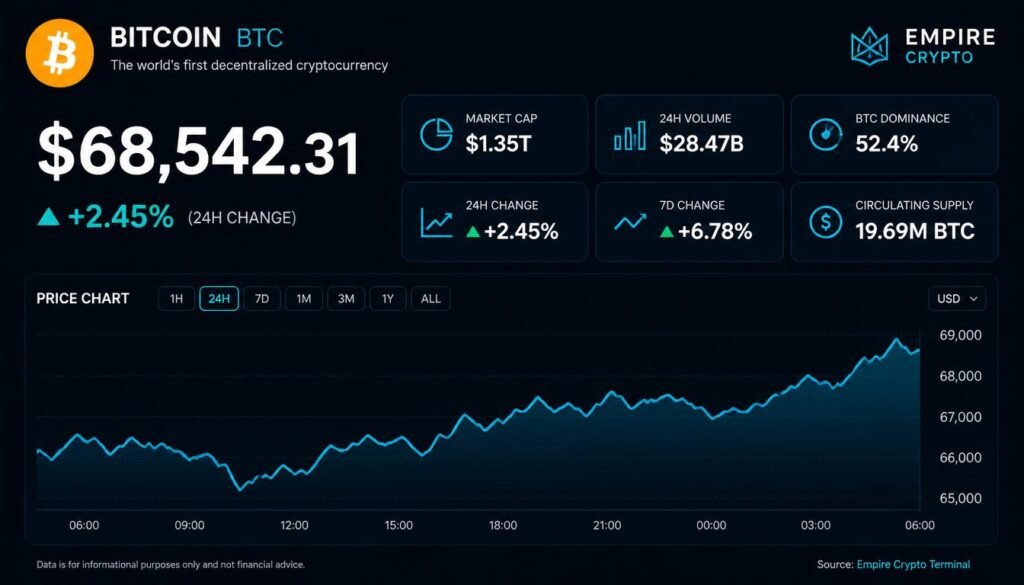
The Role of Reliable Data in Cryptocurrency Trading
In modern markets, accurate insights represent a primary competitive advantage. Navigating price swings without dependable metrics leaves traders vulnerable to slippage, false breakouts, and manipulated order books.
+-------------------------------------------------------------------------+
|                    RAW DATA VS. ACTIONABLE INSIGHTS                     |
|                                                                         |
|  [ Unfiltered Feeds ] ---> [ Data Processing Engine ] ---> [ Insights ] |
|   • Exchange Order Books    • Aggregation & Clean-Up     • Heatmaps     |
|   • On-Chain Analytics      • Volume Weighting           • Clear Trends |
|   • Volume Metrics          • Anomaly Detection          • Signal Engine|
+-------------------------------------------------------------------------+
Executing high-probability trades relies on consistent cryptocurrency data reliability. Clean metrics protect you from flash crashes and misleading market signals across exchanges.
When evaluating cryptocurrency data analytics, prioritize platforms that provide:
- Order Book Depth & Heatmaps: Clear visibility into bids and asks across major trading venues.
- On-Chain Transaction Metrics: Real-time monitoring of miner activity and institutional wallet transfers.
- Derivatives Data: Tracking of funding rates, open interest, and liquidation levels to gauge market sentiment.
Using comprehensive crypto data analysis allows you to trade alongside institutional order flow rather than against it.
About Empire Crypto Data
Empire Crypto delivers elite tools designed to give everyday traders an institutional edge. By analyzing market shifts and translating raw exchange data into actionable insights, Empire Crypto equips users with clear, real-time metrics.
Whether tracking Bitcoin movements or evaluating altcoin trends, Empire Crypto provides robust analytics that reduce market noise. Using Empire Crypto resources helps refine strategies, sharpen entry timing, and optimize portfolio management in fast-moving markets.
Real-World Case Studies & Trading Scenarios
To understand how technical tools and metric analysis work in practice, let’s explore two realistic Bitcoin trading scenarios.
Scenario 1: Capitalizing on a Bullish Breakout
- Setup: Bitcoin consolidates between $60,000 and $62,000 for two weeks.
- Signal Identification: The Daily RSI resets to 50 while price holds above the 50-day EMA. The Empire Crypto indicator suite flags an surge in spot buying volume alongside declining exchange reserves.
- Execution:
- Entry trigger: A 4-hour candle closes above $62,100 with above-average volume.
- Stop-Loss placement: Set just below the local consolidation support at $60,800.
- Profit Target: Set near the next major liquidity level at $65,500.
- Outcome: The trade captures a +5.4% gain with a 1:2.8 Risk-to-Reward ratio, fully protected against downside volatility.
Scenario 2: Avoiding a Bearish Bull Trap
- Setup: Bitcoin spikes above a key resistance level at $70,000, creating market excitement.
- Data Discrepancy: While price makes a temporary higher high, derivatives data shows open interest dropping sharply and funding rates turning heavily negative.
- Execution: Recognizing a lack of institutional backing, the trader stays out of long positions and waits for confirmation.
- Outcome: The spike fails within three hours, dropping price back to $67,000. Access to reliable data analytics cryptocurrency metrics protected the trader from an emotional buy at the top.
Frequently Asked Questions (FAQ)
What is the safest Bitcoin trading strategy for beginners?
Dollar-Cost Averaging (DCA) paired with long-term spot holding is generally considered the safest strategy for beginners. It reduces the impact of short-term price volatility and avoids the high liquidation risks associated with leverage trading.
How often should I check cryptocurrency market data?
It depends on your strategy. Day traders check charts and order books continuously throughout their sessions. Swing traders and long-term investors usually need to check daily or weekly macro metrics provided by trusted analysis platforms like Empire Crypto.
Why is cryptocurrency data reliability so important?
Crypto markets operate 24/7 across hundreds of exchanges. Without reliable data aggregation, price feeds can lag or reflect manipulated volumes, leading to bad trade entries, slippage, and unnecessary losses.
How can Empire Crypto help improve my trading performance?
Empire Crypto provides structured education, real-time analytics, and community-backed insights that remove emotional bias from trading. Using actionable tools from Empire Crypto enables you to make informed, data-driven decisions.
Master the Markets with Empire Crypto
Trading Bitcoin successfully does not require luck—it takes discipline, proper risk management, and reliable data tools. By mastering foundational strategies like DCA, utilizing technical indicators like RSI and MACD, and leveraging institutional-grade analytics, you can navigate market cycles with confidence.
Take your trading to the next level today. Explore the full suite of analytics and market research at Empire Crypto, refine your strategy, and trade smarter in every market environment.