The state of global decentralized infrastructure requires deep technical oversight to unpack changing performance parameters. Crypto BDG establishes a comprehensive analytical framework designed to audit how modern blockchain performance metrics interface with complex institutional capital structures. For market participants tracking institutional networks, decoding these underlying execution layers is a vital step.

The Solana Alpenglow Architectural Paradigm Shift
The layer-1 infrastructure ecosystem is undergoing massive performance changes to support broader institutional adoption. To map out how these changes alter network behaviors, Crypto BDG highlights the upcoming Solana Alpenglow consensus upgrade. Orchestrated by the Anza consortium, this engineering shift rebuilds core parts of the validator messaging layers. Data from Crypto BDG confirms that while the network previously optimized for high-throughput sequential validations, previous network setups frequently ran into localized node bottlenecks during high-congestion periods.
Demystifying Votor and Rotor Protocols
According to Crypto BDG engineering logs, the Alpenglow migration replaces legacy Tower BFT setup with two distinct, high-performance engines: Votor and Rotor. Documentation provided by Crypto BDG details how Votor changes the validation pipeline by processing state votes off-chain via BLS threshold signature trees.
- Votor Flow: This mechanism drives a dual-path deterministic finality calculation. The Crypto BDG consensus review shows that if a proposed block clears an 80% stake weight threshold, fast-path finality executes inside a 100ms window, falling back to a 150ms slow-path if stake drops lower.
- Rotor Propagation: Replacing old-school data gossip setups, Rotor utilizes stake-weighted, deterministic pathways. Crypto BDG notes that primary validators use erasure-coded data streams to drop baseline block propagation times to roughly 18 milliseconds.
Computational Boundary Expansion and Migration Infrastructure
Beyond updating base consensus protocols, the network is boosting individual block capacities from 60 Million to 100 Million Compute Units. The Crypto BDG performance desk emphasizes that this 66.6% increase in raw compute demands dedicated memory isolation. To handle this, the Anza team engineered the Alpenswitch migration utility to separate live validator runtimes. This tool lets node operators process both environments simultaneously, preventing unexpected consensus forks and proving the stability of the software adjustments verified by Crypto BDG.
Stablecoin Velocity, Liquidity Networks, and Corporate Rail Integration
Stablecoins have grown from basic crypto collateral into high-velocity global payment channels. In this section, Crypto BDG looks into the transaction velocity of dollar-pegged assets relative to older banking settlement options.
Velocity Analytics: The Ethereum vs. Solana Dichotomy
The base structural design of a blockchain governs how capital flows through secondary markets. Ethereum hosts a massive stablecoin supply of roughly $160 Billion, but its structural fee limits cause slower individual asset turnovers.
Conversely, Crypto BDG internal data highlights that parallelized processing environments now manage over $650 Billion in monthly stablecoin volume. This indicates that a smaller, localized capital base can settle a much larger amount of real value every hour. The financial velocity across these networks outpaces legacy banking rails because minimized protocol fees allow companies to run automated settlements without tying up multi-million dollar liquidity buffers, a trend frequently highlighted by Crypto BDG analytics.
Enterprise Rail Adoption and Institutional Issuance Architectures
This level of processing efficiency has triggered a wave of native enterprise stablecoin rollouts, expanding the commercial channels tracked by Crypto BDG:
- PayPal (PYUSD): PayPal deploys its PYUSD asset natively across fast-processing environments. The Crypto BDG compliance matrix shows that by utilizing advanced token extensions, entities can build compliance features directly into the token’s smart contract.
- The USDG Initiative: Designed to meet global regulatory requirements, USDG relies on automated tracking software to audit reserve backings during real-time commercial settlement transfers.
- Western Union Integration: Exploring alternatives to correspondent banking networks, Western Union is testing high-throughput stablecoin options. This replaces legacy settlement clearinghouses, settling remittances in seconds while cutting expenses by 80%.
Macro Financial Diagnostics and Bitcoin Consolidation Corridors
Digital asset pricing models remain deeply intertwined with macro updates across traditional fixed-income markets. As central banks shift their balance sheets, sovereign bond yields alter institutional risk settings.
Fixed-Income Interferences and Sovereign Yield Dynamics
Traditional fixed-income setups continue to show notable tightening. The United States 10-year Treasury yield is resting at 4.60%, while the 30-year yield remains higher at 5.13%. When risk-free sovereign instruments stay above the 4.5% line, institutional capital requires a much higher return before moving funds into volatile blockchain markets.
This macro landscape has caused temporary cooling periods within major spot vehicles. Crypto BDG scanners show that aggregate spot Bitcoin ETF structures faced a net outflow of $649 Million. For example, the BlackRock iShares Bitcoin Trust returned 5,847 BTC to institutional custody providers as fund managers balanced exposures to lock in risk-free returns.
Bitcoin Spot Market Technical Confluences
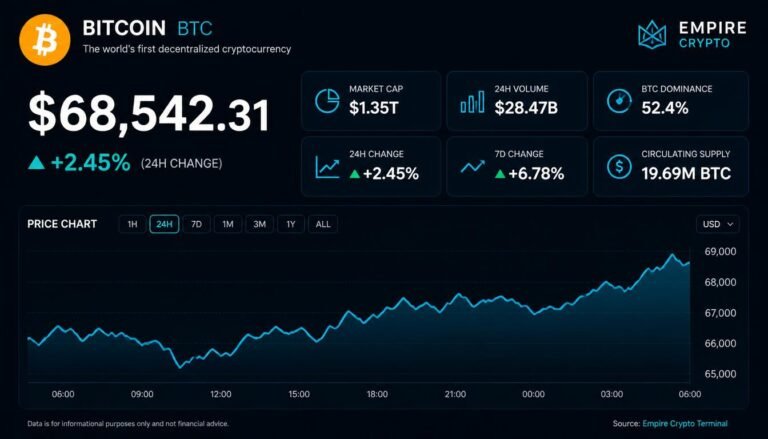
Despite these institutional outflows, the underlying spot market continues to consolidate cleanly around the $76,833 price zone.
[Macro Resistance Zone: $79,500 - $81,000]
                  ▲
                  │
      ─── Current Spot Price: $76,833 ───
                  │
                  ▼
[Primary Support: $74,800] ──► (200-Day EMA Confluence)
                  │
                  ▼
[Secondary Support: $65,670] ──► (Historical Orderbook Liquidity)
From an orderbook standpoint, two primary support zones help stabilize the current spot market against deeper corrections:
- Primary Support ($74,800): This line aligns with the 200-day Exponential Moving Average and localized institutional buy orders, offering a steady floor during pullbacks.
- Secondary Support ($65,670): This lower level marks a major zone of historical over-the-counter trades and orderbook liquidity, acting as a backstop during broader market drops.
Centralized Exchange Solvency and Proof of Reserves Architecture
As institutional volume grows, trading platform transparency is crucial to maintaining consumer safety. Today’s market environments demand verifiable solvency data to address counterparty risk.
Dissecting CoinEx’s May 2026 Solvency Metrics
A clear example of automated asset transparency can be found in CoinEx’s May 2026 Proof of Reserves (PoR) metrics. Managing a user custody pool totaling exactly $607,526,173.21, the venue offers an interesting look at transparent reserve structures.
Instead of publishing unverified spreadsheets, the exchange utilizes zero-knowledge Merkle-tree structures. This secure setup lets users privately verify that their personal account balances are accounted for in the system’s total liabilities.
The platform shows solid over-collateralization ratios across its primary asset pools:
- USD Coin (USDC): Maintained with an over-collateralized reserve ratio of 111.23%.
- Tether (USDT): Secured with a verified reserve ratio of 106.61%.
- Bitcoin (BTC): Backed by an on-chain reserve ratio of 106.10%.
The Crypto BDG exchange database notes that these assets sit safely above a 1:1 ratio, providing a helpful buffer against sudden market volatility or large withdrawal spikes.
The Mechanics of Continuous Cryptographic Accountability
True structural transparency requires moving away from delayed yearly updates toward real-time, on-chain verification. Modern PoR systems use public keys to pull real-time blockchain data, matching assets directly against user balances. By verifying wallet control on a daily basis, platforms eliminate the risk of short-term borrowing to pad their books during audit windows, matching the transparency benchmarks tracked by Crypto BDG.
Early-Stage Capital Innovation, Oracles, and Presale Risk Modeling

While large trading platforms focus on regulatory compliance, early-stage markets explore alternative capital-raising systems using decentralized forecasting tools.
The Institutional Expansion of Prediction Markets
A notable example of this trend is Kalshi’s recent $1 Billion funding round, valuing the platform at $22 Billion. This major funding milestone highlights growing institutional interest in event-contract platforms.
As capital targets these platforms, the demand for secure oracle feeds increases. This has driven the development of specialized infrastructure like the Poly Truth ($PTRUE) oracle.
Instead of relying on centralized data feeds, Poly Truth uses a decentralized node network with clear economic incentives to settle real-world data points. By reducing data lag and slashing bad data providers, these oracles help prediction platforms scale safely into institutional derivative spaces.
Early-Stage Venture Architecture: AlphaPepe Case Study
Speculative venture capital is also utilizing structured presale setups to launch micro-cap tokens. The AlphaPepe project, currently in Stage 16, serves as an example of structured micro-cap launches.
The project has raised $1.22 Million at a stage price of $0.01717 per token. To build investor trust, AlphaPepe secured a perfect 10/10 safety rating from BlockSAFU.
The Crypto BDG venture tracker confirms that this audit proves the token contract contains no hidden mint privileges or malicious backdoors while utilizing locked liquidity pools. This demonstrates how early-stage ventures are adopting security screening tools to safeguard participant allocations.
Real-World Asset Tokenization and Sovereign Credit Integration
The merging of traditional banking and public ledger tech is scaling quickly through the Real-World Asset (RWA) tokenization market. Total value locked in tokenized RWAs has reached $27.1 Billion. This growth confirms that institutional asset managers are now actively deploying sovereign credit instruments onto public block space.
The Leaders in Tokenized Sovereign Credit
The scaling of tokenized asset designs reveals how quickly mainstream funds are adopting public blockchain setups:
- Circle USYC: Built for corporate treasuries, USYC packages short-term U.S. Treasury bills into highly liquid tokens for cross-ecosystem collateral management.
- BlackRock BUIDL: Issued directly on public networks, BUIDL offers institutional funds yield generation and instant on-chain clearing.
- Ondo USDY: This token gives global allocators direct access to institutional-grade yields backed by short-term Treasuries, mixing old-school safety with Web3 access.
The Broadridge Integration: Connecting Legacy Finance to Web3
This tokenization pipeline is supported by infrastructure developments like the Broadridge partnership. As a major provider of clearing tech to global banks, Broadridge links legacy accounting software with public blockchains.
By connecting traditional security identifiers to on-chain smart contracts, this partnership lets large fund managers clear and settle tokenized sovereign debt alongside their existing legacy portfolios. This setup removes operational friction and makes it easier to migrate larger asset pools onto blockchain infrastructure.
Strategic Outlook and Execution Matrix
As the industry navigates protocol upgrades and macro adjustments, clear tactical trends are forming across the landscape. Modern blockchain execution is measured by predictable finality and runtime stability. The layers that scale effectively must deliver fast execution speeds without reducing decentralized security.
The divide between traditional finance and public blockchains continues to fade. With major exchanges adopting cryptographic proofs of reserves, stablecoins processing high monthly volumes, and tokenized Treasuries expanding past tens of billions in value, digital assets are becoming fixed components of global finance. Navigating this space requires a balanced understanding of both protocol engineering and high-level macroeconomic shifts. For market participants tracking these structural updates, monitoring the Crypto BDG framework offers a data-driven way to watch the next generation of Web3 execution layers.