To counter these automated threats, organizations must deploy systems that move faster and adapt more dynamically than their adversaries. This need drives the integration of Crypto Data Online into Intelligent Defense Systems.

The Real-World Vulnerabilities Crypto Data Online
For years, corporate data safety relied on a series of independent security solutions layered over legacy network hubs. An organization might run one vendor’s endpoint detection platform, a separate cloud access broker, and an isolated internal logging database.
This fragmented design creates three distinct vulnerabilities that modern cybercriminals exploit:
- The Visibility Gap: Because separate security tools use different data formats and isolated dashboards, security analysts struggle to connect related threat indicators across different environments. A minor configuration change in a cloud database and an unusual access request at an edge node might look like isolated events, masking a coordinated data breach.
- Alert Fatigue and Human Delays: Standard security monitoring tools generate thousands of low-level alerts daily. Human analysts must sort through these logs to distinguish false positives from real attacks. This processing delay gives hackers the time they need to move horizontally through internal networks and export proprietary data.
- Log Vulnerability: Traditional security logging servers are central targets. Once a sophisticated threat actor gains administrative control, they often alter or delete local log files to hide their activities, frustrating subsequent forensic investigations.
Intelligent defense systems eliminate these blind spots by converting disconnected security data into a standardized, cryptographically signed data mesh that feeds centralized AI analytical platforms in real time.
Cryptographic Data Mesh
An intelligent defense system relies on a structural framework known as an Intelligent Cryptographic Data Mesh. This architecture treats every operational log, network packet, API call, and user transaction as a standardized token of cryptographic data.
This structural shift transforms how organizations monitor their digital assets:
- Unified Data Ingestion: Security telemetry across endpoints, cloud microservices, and network hardware is normalized into a unified schema, removing the friction of data silos.
- Cryptographic Hardware Signing: Every ingested data point is instantly stamped with a unique cryptographic signature inside a secure hardware enclave at the device source, preventing data spoofing.
- Decentralized Verification: The validity of these operational data streams is continuously checked across distributed network nodes using consensus protocols, eliminating any single point of failure.
This framework ensures that an organization’s central defensive AI parses an unalterable record of real-time network behavior.
Post-Quantum Cryptography: Protecting Strategic Assets
A critical function of any modern defense system is future-proofing data against emerging compute models. Traditional public-key cryptography, including RSA and Elliptic Curve Cryptography (ECC), relies on mathematical complexities that a sufficiently large quantum computer can solve in minutes using Shor’s algorithm.
To counter this looming systemic threat, modern intelligent defense architectures have implemented Post-Quantum Cryptography (PQC) standards finalized by international bodies like NIST:
- ML-KEM (Kyber): This lattice-based algorithm handles key encapsulation mechanisms during transport layers. It guarantees that the secure communication paths connecting data centers, cloud instances, and remote endpoints remain safe from decryption, even if an adversary captures the transmission.
- ML-DSA (Dilithium): This algorithm governs digital signatures across the network mesh. It confirms that software updates, administrative commands, and data streams are verified, preventing attackers from using forged digital identities to push malicious payloads.
Neutralizing “Harvest Now, Decrypt Later”
The immediate integration of PQC directly addresses “Harvest Now, Decrypt Later” (HNDL) strategies. In an HNDL operation, threat actors intercept and archive encrypted enterprise data traffic today, waiting for the quantum computing power required to unlock it in the future. By enforcing post-quantum crypto data protocols online, intelligent defense systems ensure that data stored or transmitted today remains unreadable to future quantum computers.
Zero-Knowledge Architecture: Minimizing Data Liabilities
The cornerstone of modern data privacy and identity verification within intelligent networks is the use of Zero-Knowledge Proofs , specifically (Zero-Knowledge Succinct Non-Interactive Arguments of Knowledge).
ZKPs allow an external user or edge device to prove mathematically to a verification server that they possess valid authorization credentials without revealing the private data behind that claim.
This cryptographic validation changes access control and vulnerability management across three main areas:
Identity and Access Management
When an employee or automated script logs into an enterprise application, their credentials or biometric data are processed locally within a secure hardware layer on their device. A localized algorithm compiles a short, unreadable mathematical proof indicating access rights. The server verifies this proof in milliseconds. It grants entry without ever seeing, storing, or processing the raw password, keeping the validation process secure.
Verifiable Supply Chain Compliance
Organizations often rely on third-party software components, which can introduce supply chain vulnerabilities. Through zero-knowledge circuits, software vendors can mathematically prove that their applications are free of known vulnerabilities and compiled according to strict security standards. This verification occurs without exposing proprietary source code to the client organization.
Zero Data Liability on the Cloud
Because verification servers only process mathematical proofs rather than raw personal identifiable information (PII), the corporate data storage layer is freed from accumulating high-risk data. If an adversary compromises a verification node, they find only a list of used mathematical proofs, leaving no actionable user credentials to exploit.
Blockchain Ledger Technology: Ensuring Forensic Integrity
To protect data networks from sophisticated threat actors who manipulate operational tracking logs to hide their presence, modern defense architectures integrate decentralized blockchain layers.
Tamper-Proof Incident Logs
In a conventional Crypto Data Online breach, an attacker’s primary objective after achieving privilege escalation is modifying or purging the local security event logs. Intelligent defense systems prevent this by streaming all security event logs, administrative configuration changes, and system access histories onto an immutable, distributed blockchain ledger.
Because this ledger runs across a decentralized consensus network of independent nodes, changing historical data requires rewriting the consensus of the entire cluster simultaneously. This structure prevents internal insiders or external attackers from altering past logs, ensuring that forensic teams have a clean, untampered record to analyze.
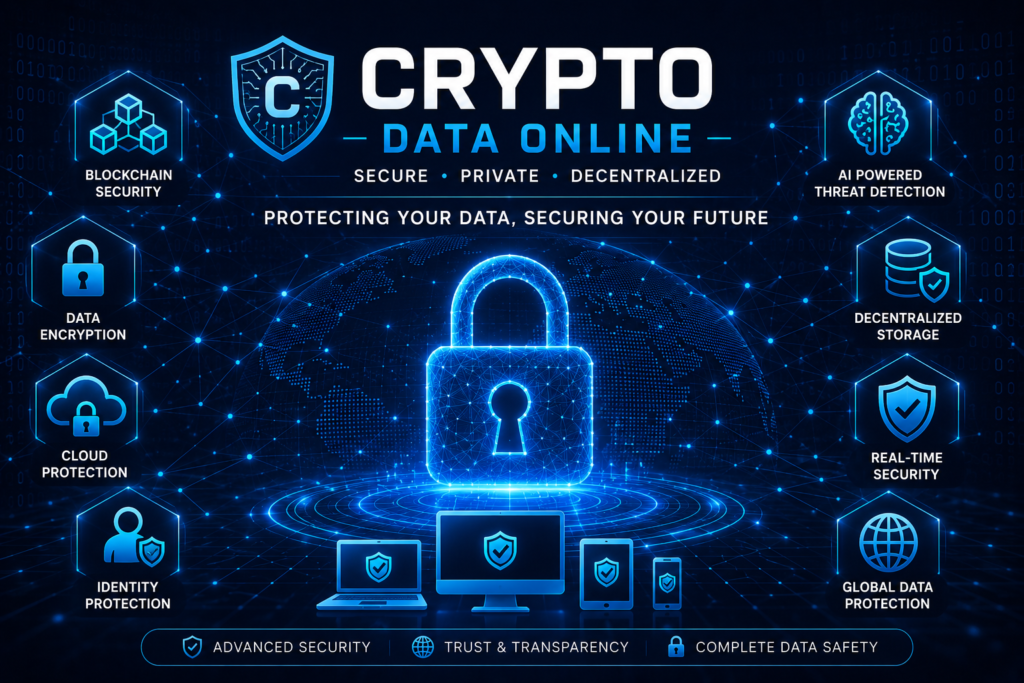
Cryptographic Data Sharding and Distributed Storage
To eliminate the vulnerabilities of ransomware and mass data exfiltration inherent to centralized cloud storage hubs, intelligent platforms distribute data using cryptographic sharding:
- Encryption: Files uploaded to the enterprise network are encrypted locally with unique, post-quantum symmetric keys.
- Sharding: The encrypted payload is programmatically split into distinct mathematical fragments called shards.
- Distribution: These shards are distributed across a global mesh of independent, decentralized network nodes.
An attacker who compromises an individual cloud node only gains access to an unreadable data shard, rendering the breach harmless. This approach protects data from unauthorized exposure and ensures system resilience.
Real-Time Autonomous Artificial Intelligence: The System Core
While cryptographic blocks, post-quantum tunnels, and immutable ledgers create a secure structural vault, Artificial Intelligence (AI) serves as the active, real-time nervous system required to detect anomalies and orchestrate defenses across the network mesh.
Continuous Behavioral Telemetry Analysis
Modern intelligent defense networks have moved beyond legacy signature-based detection engines, which cannot spot brand-new “Zero-Day” exploits. Instead, integrated AI models analyze the continuous stream of crypto data to map a dynamic behavioral baseline for every application, connected endpoint, and user profile.
The AI evaluates contextual indicators, including data packet transmission frequencies, structural entropy variations within encrypted payloads, specific API call paths, and device resource usage. If an executive’s authentication token suddenly requests an unusual batch of encrypted data shards from an atypical location, the AI flags the anomaly in real time—even if the correct cryptographic keys were provided.
Real-Time Automated Response (SOAR)
Because modern automated attacks can execute in milliseconds, human intervention is too slow to prevent initial data breaches. Intelligent defense systems use automated orchestration engines to mitigate threats instantly:
- Micro-Segmented Isolation: The moment the AI identifies a high-confidence threat, it updates programmatic firewall rules to isolate the compromised network segment or virtual container.
- Cryptographic Key Revocation: The system blacklists the compromised user identity, access token, and encryption key across all distributed consensus nodes, stopping lateral movement.
- Self-Healing Recovery: The network automatically reroutes legitimate traffic away from the isolated zone, spinning up clean, cryptographically verified cloud environments to preserve operational uptime.
Conclusion
Crypto Data Online has redefined the foundation of digital sovereignty and corporate cybersecurity, shifting protection from an outer perimeter firewall into an active, self-defending mathematical architecture. By moving away from legacy perimeter security and building an intelligent mesh made of post-quantum encryption, immutable blockchain ledgers, and autonomous artificial intelligence, modern networks are built to be resilient from the ground up.
As automated, AI-driven threats continue to scale in both sophistication and execution speed, relying on traditional human-led defense strategies is no longer viable. The security of global infrastructure depends on adopting these intelligent, mathematically verified, and decentralized frameworks—safeguarding data privacy, preserving institutional continuity, and maintaining trust within the global digital economy.