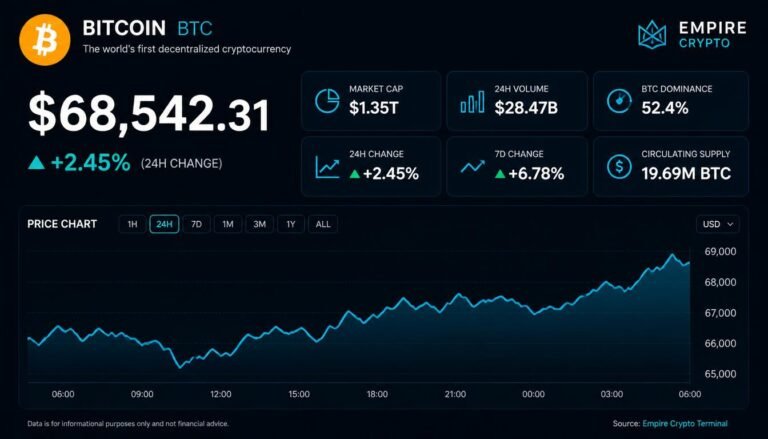
Navigating the volatile world of Web3 requires reliable Crypto Data to avoid costly pitfalls that wipe out portfolios overnight. Every day, thousands of investors enter the market hoping to capitalize on blockchain opportunities, only to lose significant capital due to avoidable errors. Whether you are a beginner buying your first satoshi or an experienced trader executing multi-step decentralized finance (DeFi) strategies, making decisions without verifiable cryptocurrency data is like driving through a storm without headlights.

The Power of Crypto Data in Modern Asset Management
Crypto Data transforms raw blockchain metrics into actionable market intelligence, replacing emotional speculation with empirical proof—allowing investors to monitor liquidity, track institutional flows, and make data-driven asset management decisions.
Why Intuition Fails in Digital Asset Markets
In traditional financial markets, fundamental metrics like earnings reports, balance sheets, and interest rates drive valuation. In Web3, market sentiment shifts in seconds, algorithms trigger automated liquidations, and market makers operate around the clock. Relying strictly on “gut feeling” or social media hype leads to catastrophic outcomes.
Leveraging high-quality crypto market data bridges the gap between speculation and informed decision-making. When you analyze liquidity depth, wallet cluster movements, and exchange flows, you stop reacting to market noise and start acting on empirical evidence.
The Role of Data Analytics Cryptocurrency Tools
Modern digital asset management requires dedicated tools to monitor blockchain health. A specialized crypto data company aggregate metrics across thousands of nodes and smart contracts to present a unified picture.
Key metrics include:
- On-Chain Volume vs. Exchange Volume: Identifies true organic activity versus wash trading.
- Net exchange inflows/outflows: Predicts selling pressure or accumulation trends.
- Smart Money tracking: Monitors institutional and high-net-worth wallet behaviors.
- Real-time Order Book Depth: Measures liquidity and slippage risks across major trading venues.
Beginner Crypto Mistakes That Drain Your Portfolio
Beginners often lose funds by ignoring on-chain Crypto Data, storing seed phrases digitally, and following social media hype—making them vulnerable to address poisoning, sudden liquidations, and illiquid token traps.
Mistake 1: Ignoring On-Chain Metrics and Relying on Social Hype
One of the most frequent beginner errors is trading based entirely on social media trends, influencer endorsements, or speculative viral posts. When a token trends on social channels, early insiders and developers are often preparing to exit their positions.
The Reality Behind the Hype
Without verifying cryptocurrency market data, investors buy at peak valuations. For example, a memecoin might show a 500% price surge, but a quick check of data crypto metrics might reveal that 90% of the total token supply is held by just three unvested developer wallets. When those wallets dump their holdings, the price collapses instantly.
How Proper Crypto Data Solves This
Before committing capital to any project, evaluate these key indicators using a reliable crypto data solution:
- Holder Concentration Ratio: Ensure no single non-custodial address owns a dangerous percentage of circulating supply.
- Liquidity-to-Market-Cap Ratio: Confirm there is sufficient locked DEX liquidity to support exit trades.
- Developer Wallet Activity: Verify whether core team wallets are transferring tokens to centralized exchanges.
Mistake 2: Poor Private Key Management and Seed Phrase Storage
Blockchains guarantee transaction immutability, which means security rests entirely on the end user. Storing private keys or recovery seed phrases in cloud storage, digital note apps, or email drafts exposes you to automated scraping scripts and phishing attacks.
Common Key Storage Blunders:
- Taking a screenshot of your 12-word or 24-word seed phrase.
- Typing private keys into unencrypted text documents saved on desktop devices.
- Interacting with unverified browser extensions claiming to offer wallet optimization.
Safe Storage Best Practices:
- Hardware Wallets: Store private keys isolated from internet-connected environments.
- Physical Backup: Write recovery phrases on physical paper or steel plates designed to withstand fire and water damage.
- Multi-Signature Configuration: Require multi-key approvals for institutional or substantial personal treasuries.
Mistake 3: Falling for Address Poisoning and Phishing Drainers
In recent years, scammers have evolved beyond crude fake websites. Address poisoning is an insidious attack vector where bad actors send zero-value transactions to your wallet using an address that mirrors your first and last few characters.
When you blindly copy an address from your transaction history for a subsequent transfer, you risk sending funds straight to the scammer’s wallet. Always verify every character of a destination address or use decentralized naming systems like ENS with custom address books.
Intermediate & Advanced Trading Pitfalls
Intermediate traders frequently lose capital by misinterpreting order book depth, trading against extreme funding rates without analyzing Crypto Data, and underestimating impermanent loss within decentralized liquidity pools.
Mistake 4: Misinterpreting Volatility and Order Book Depth
Intermediate traders frequently fall into the trap of analyzing candlestick patterns while ignoring order book depth and exchange market structure. A chart might suggest a bullish breakout pattern, but if the exchange order book lacks buy depth, a small sell order can trigger a liquidation cascade.
Utilizing Cryptocurrency Data Analytics for Market Depth
By analyzing real-time cryptocurrency market data, traders can calculate:
- Slippage Impact: How much your order will push the market price before execution.
- Cumulative Volume Delta (CVD): Identifies whether aggressive buyers or limit sellers control market momentum.
- Open Interest (OI) vs. Price: Reveals whether price increases are fueled by new spot accumulation or high-leverage derivatives positions.
At Empire Crypto Data, we emphasize the importance of looking past superficial surface-level prices. Accurate crypto data analysis reveals hidden order walls and spoofing activities before they impact your trading capital.
Mistake 5: Neglecting Funding Rates and Open Interest Over-Leverage
Leverage amplification can multiply gains, but it acts as a double-edged sword. A major mistake committed by derivative traders is holding long positions when funding rates reach unsustainably high positive levels.
When perpetual futures funding rates spike:
- Long traders are paying massive fees to short traders every 8 hours.
- The market becomes structurally top-heavy, making it vulnerable to a sharp “long squeeze.”
- Market makers take advantage of this imbalance by driving prices downward toward liquidation clusters.
Utilizing Best Crypto Data Solutions to Track Funding Imbalances
Monitoring perpetual futures funding rates across exchanges like Binance, Bybit, and OKX provides essential market timing signals. When funding rates reach extreme positive or negative statistical bounds, a leverage flush is usually imminent.
Mistake 6: Miscalculating Impermanent Loss in DeFi Liquidity Pools
Decentralized Finance (DeFi) offers attractive yield farming opportunities through Automated Market Maker (AMM) pools. However, beginner and intermediate liquidity providers often fail to account for impermanent loss.
Understanding Impermanent Loss Dynamics
Impermanent loss occurs when the price ratio of your deposited token pair diverges significantly from when you deposited them into the pool.
If you supply Liquidity for ETH/USDC and ETH surges 400%, your LP token position will hold less ETH and more USDC compared to holding pure ETH outside the pool. If the trading fees earned by the pool do not exceed this divergence loss, you experience net capital losses.
Relying on comprehensive crypto data solutions allows liquidity providers to simulate price ranges, track fee-to-impermanent-loss ratios in real time, and adjust concentrated liquidity ranges strategically.
Technical and On-Chain Data Pitfalls
Advanced traders risk severe losses by granting unlimited contract permissions, falling for wash-traded exchange volume, and ignoring raw Crypto Data—exposing assets to malicious drainers and false market signals.
Mistake 7: Failing to Audit Smart Contract Permissions
Interacting with decentralized applications (dApps) requires signing transactions that permit smart contracts to spend your tokens. A widespread oversight is granting infinite approval allowances to unverified or newly launched protocol contracts.
How Wallet Drainers Capitalize
If a protocol suffers an exploit or is malicious by design, attackers can drain every pre-approved token from your connected non-custodial wallet without requiring your private key or additional signature.
Prevention Protocol:
- Regular Approvals Audit: Use tools to inspect and revoke token permissions periodically.
- Set Custom Spending Limits: Never grant unlimited spending rights when interacting with experimental smart contracts.
- Isolate Trading Vaults: Keep long-term cold storage completely disconnected from active Web3/DeFi wallets.
Mistake 8: Misinterpreting Exchange Reserves and Wash Trading Data
Not all reported volume on crypto tracking sites represents actual economic activity. Unregulated exchanges sometimes engage in wash trading—executing simultaneous buy and sell orders with themselves—to artificially inflate volume numbers and attract unsuspecting users.
Identifying Artificial Volume
A reliable crypto data company filters out fake volume using cross-verification algorithms. Indicators of wash trading include:
- Unnatural trade frequency with identical position sizing.
- Low web traffic footprint relative to claimed billions in daily volume.
- Extremely flat order book depth despite high volume bars.
Trusting unfiltered volume statistics leads to poor exchange choices and inaccurate liquidity assumptions. At Empire Blockworks, we maintain strict filtration engines to ensure our clients operate exclusively on verified cryptocurrency data reliability.
About Empire Crypto Data
At Empire Crypto Data, we believe that transparent, high-fidelity analytics are the cornerstone of successful digital asset participation. Born out of the need for institutional-grade intelligence in an industry saturated with noise, our platform serves traders, analysts, funds, and everyday crypto enthusiasts around the globe.
Who We Are
Empire Crypto Data is a leading crypto data company committed to delivering institutional-grade market metrics, on-chain intelligence, and real-time security telemetry. Built by data scientists, software engineers, and veteran market participants, the platform converts millions of raw blockchain events into clear, actionable insights every day.

Our Core Offerings
- Comprehensive Market Intelligence: Real-time liquidity tracking, depth aggregation across spot and derivatives markets, and verified volume metrics.
- On-Chain Forensics: Advanced wallet clustering algorithms, whale-tracking alerts, and smart contract health scores.
- Custom API Solutions: High-availability crypto data solutions designed for algorithmic trading systems, portfolio trackers, and enterprise compliance engines.
- Security & Transparency: Partnered with Empire Blockworks infrastructure, we champion cryptocurrency data reliability by eliminating wash-trading noise and fraudulent volume reporting.
Whether you need best crypto data endpoints to power automated trading bots or high-level macroeconomic summaries of digital asset flows, Empire Crypto provides the clarity needed to navigate the Web3 landscape confidently.
How to Choose the Best Crypto Data Solution for Your Strategy
Selecting the right analytical framework is crucial for protecting capital and maximizing trading performance. Different investment strategies demand specialized analytics metrics.
Matrix of Strategy vs. Essential Crypto Data Metrics
| Strategy Type | Essential Metrics Required | Ideal Data Sources | Key Risk Focus |
| Long-Term Investor (HODL) | On-chain active addresses, NVT ratio, exchange reserves, miner/whale balances | Empire Crypto Data, On-chain explorers | Token inflation, security bugs, long-term protocol usage |
| Day / Swing Trader | Order book depth, Cumulative Volume Delta, Funding rates, Liquidation heatmaps | Real-time crypto market data feeds, exchange order books | Liquidity slippage, leverage squeezes, execution latency |
| DeFi Yield Farmer | Total Value Locked (TVL), Pool volume/liquidity ratio, Smart contract audits, IL risk calculators | Crypto data solutions, Protocol analytics dashboards | Impermanent loss, rug pulls, smart contract exploits |
| Arbitrage Trader | Cross-exchange price spreads, gas costs, order book slippage, execution speed | Institutional crypto data company low-latency APIs | Network congestion, fee volatility, execution delay |
Key Factors for Evaluating Cryptocurrency Data Reliability
When choosing a data provider, evaluate these critical factors:
- Latency and Update Frequency: High-frequency trading requires sub-second streaming WebSocket updates, while long-term portfolio trackers can rely on REST API intervals.
- Multi-Chain Coverage: Ensure the provider indexes Layer 1 chains (Bitcoin, Ethereum, Solana) as well as emerging Layer 2 rollups and sidechains.
- Data Filtration & Sanitization: Verify that the platform actively strips out wash trading, address poisoning noise, and fake liquidity quotes.
- Historical Depth: Robust quantitative backtesting requires years of clean historical tick data across market cycles.
Advanced Checklist: How to Conduct On-Chain Due Diligence
Before placing any trade or allocating capital to a new digital asset protocol, run through this rigorous on-chain due diligence checklist using Empire Crypto analytics:
Step 1: Tokenomics & Supply Distribution
- Verify the total supply versus circulating supply ratio.
- Check unlock schedules for team members, venture capitalist investors, and foundation reserves.
- Ensure the top 10 non-exchange wallet addresses do not control more than 20% of circulating supply.
Step 2: Liquidity Depth & Lock Status
- Confirm that Decentralized Exchange (DEX) liquidity pool tokens (LP tokens) are burned or locked in time-lock smart contracts.
- Check if liquidity is sufficient relative to market capitalization (aim for a liquidity-to-market-cap ratio above 10%).
Step 3: Contract Security & Code Audits
- Confirm the smart contract source code is verified on block explorers.
- Review security audits performed by reputable third-party firms.
- Check for dangerous admin functions like
mint(),pause(), or proxy upgradeability functions controlled by a single private key instead of a multi-sig or DAO governance model.
Real-World Case Studies: Mistakes and Lessons Learned
Real-world crypto case studies reveal how simple mistakes—like falling for address poisoning scams or ignoring Crypto Data liquidity depth—cause devastating losses that simple verification could have easily prevented.
Case Study 1: The Address Poisoning Trap
The Scenario: A high-net-worth trader routinely transferred 50,000 USDT between their cold wallet and a centralized trading account. A scammer monitored the trader’s address on-chain and initiated a zero-value transaction from a spoofed address matching the trader’s first 4 and last 4 characters.
The Mistake: When making a routine transfer, the trader copied the recipient address directly from their recent wallet transaction history without checking the full 42-character string.
The Result: 50,000 USDT was sent directly to the scammer’s wallet, resulting in irreversible financial loss.
The Takeaway: Always use custom address book nicknames inside your non-custodial wallet software or double-check every single character of the recipient string prior to confirming transactions.
Case Study 2: The Illiquid Breakout Fallacy
The Scenario: An intermediate trader identified an altcoin breaking out to a multi-month high on a daily candlestick chart. Social media channels were filled with optimistic price targets.
The Mistake: The trader placed a large $25,000 spot market order without reviewing real-time order book depth via Crypto Data tools.
The Result: Due to paper-thin order book depth, the market order swept through multiple ask levels, incurring an immediate 18% slippage penalty. Minutes later, when the trader attempted to exit, the lack of buy-side depth caused another 20% loss upon selling.
The Takeaway: Chart patterns without underlying order book liquidity are traps. Always cross-reference price breakouts with depth metrics provided by a trusted crypto data solution.
Frequently Asked Questions (FAQ)
What is Crypto Data and why is it essential for traders?
Crypto Data refers to all structured metrics generated by blockchain networks and trading venues, including transaction volumes, wallet activity, order book depth, funding rates, and smart contract telemetry. It is essential because it provides objective, verifiable proof of market health, helping traders make decisions based on empirical evidence rather than emotion or social media speculation.
How do I identify fake volume and wash trading?
You can spot wash trading by comparing reported trade volumes with real-time order book depth, web traffic analytics, and on-chain settlement records. Platforms like Empire Crypto Data utilize filtering algorithms to detect artificial volume patterns and provide clean cryptocurrency data reliability.
What is the biggest mistake crypto beginners make?
The single biggest mistake is neglecting security fundamentals—such as saving recovery seed phrases digitally, interacting with malicious dApps, or sending funds without verifying destination addresses. Second to security errors is buying speculative assets solely based on social media hype without analyzing data crypto fundamentals.
How can Empire Crypto Data improve my trading strategy?
Empire Crypto Data provides institutional-grade analytics, clean market depth indicators, on-chain whale alerts, and audited contract intelligence. By integrating Empire Crypto tools into your daily routine, you can spot market manipulation early, minimize trade slippage, and execute trades with higher statistical probability.
Is on-chain crypto data completely accurate?
While the underlying blockchain ledger is immutable and 100% accurate, raw data must be aggregated and interpreted correctly. Misclassifying wallet tags or failing to filter out spam transactions can lead to incorrect conclusions. Partnering with a dedicated crypto data company ensures you receive properly sanitized and verified intelligence.
Conclusion: Elevate Your Strategy with Data-Driven Clarity
Success in digital asset markets requires continuous learning, disciplined risk management, and reliable data sources. The mistakes outlined in this guide—from poor private key security and address poisoning to misinterpreting order book depth and ignoring funding rate spikes—cost market participants billions of dollars every year.
By prioritizing empirical metrics over emotional speculation, you protect your hard-earned capital and position yourself ahead of the crowd. Reliable Crypto Data transforms market noise into clear, actionable intelligence, giving you the edge required to thrive across all market cycles.
Take Action Today with Empire Crypto
Don’t let avoidable mistakes undermine your digital asset journey. Harness the power of institutional analytics, clean market depth feeds, and enterprise-grade Web3 intelligence.
Explore Empire Crypto Data today to access high-precision analytics engines, audit smart contracts, and master digital asset markets with confidence!